

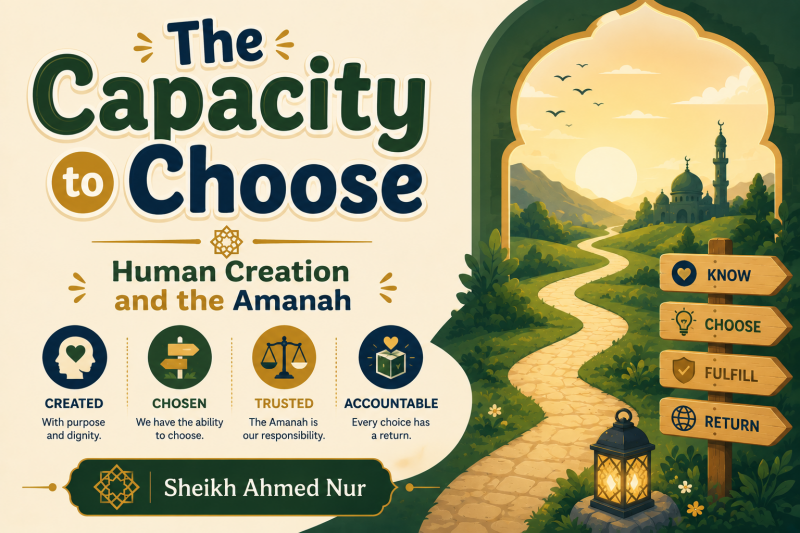
Look closely at the natural world, and a distinct boundary begins to appear. Everything around us operates within an order it does not stop to question. A river follows the pull of gravity. A tree grows toward light. An animal responds to hunger, danger, and instinct. The world around us moves according to the nature given to it.
Human beings are different in a particular way. We can pause.
We can feel anger and still ask whether we should act on it. We can want something and question whether pursuing it is right. We can recognize a truth that costs us something and decide whether to follow it or turn away. There is an interior space between what we experience and what we do, and within that space lies the capacity to choose.
That capacity is easy to take for granted because it is part of our ordinary experience. We make decisions throughout the day without stopping to consider what makes choice possible in the first place. Yet the ability to choose changes the nature of human life. We are not simply moved by every impulse that passes through us. We can examine an impulse, resist it, follow it, or choose another course.
The Qur’an points to this distinctive human capacity when it says:
(لقَدْ خَلَقْنَا الْإِنسَانَ فِي أَحْسَنِ تَقْوِيم)
“Indeed, We created the human being in the best of stature.” — Qur’an 95:4
The verse speaks of human creation with a dignity that is more than physical form. Human beings possess capacities that allow them to understand, deliberate, recognize right and wrong, and direct their actions. We are capable of responding to what we know rather than simply reacting to what we feel.
But the ability to choose raises another question. If human beings are given genuine freedom to make choices, what is that freedom for? And what makes those choices morally significant?
The answer leads to the concept of the Amanah.
The Qur’an states:
(إِنَّا عَرَضْنَا الْأَمَانَةَ عَلَى السَّمَاوَاتِ وَالْأَرْضِ وَالْجِبَالِ فَأَبَيْنَ أَن يَحْمِلْنَهَا وَأَشْفَقْنَ مِنْهَا وَحَمَلَهَا الْإِنسَانُ)
“Indeed, We offered the Trust to the heavens and the earth and the mountains, but they declined to bear it and feared it; yet the human being undertook it.” — Qur’an 33:72
This verse invites us to pause and consider what it means. Whatever else the Amanah encompasses, one truth is unmistakable: human life carries responsibility. The trust is real, and human beings have taken it upon themselves. Responsibility here is not an abstract idea. The Qur’an does not present freedom as simply having permission to do whatever we want. Freedom carries weight because the choices we make have real consequences.
Free will and the Amanah are inseparable, yet distinct. Free will is the capacity to choose; the Amanah is the responsibility that comes with what we choose. Choice makes action possible, but the Amanah gives those choices their moral weight.
This also means that human freedom should not be confused with complete independence. We are free to choose within circumstances we did not choose for ourselves. None of us chooses the hour or place of our birth, the family into which we are born, the length of our lives, or the trials that come our way. We do not decide every condition that shapes our circumstances. Much of existence arrives without our choosing it.
Yet within those circumstances, something remains ours.
The Qur’an states this plainly:
(إِنَّا هَدَيْنَاهُ السَّبِيلَ إِمَّا شَاكِرًا وَإِمَّا كَفُورًا)
“Indeed, We guided him to the way, whether he is grateful or ungrateful.” — Qur’an 76:3
Guidance is offered, but the response remains ours to choose. We may follow the truth or turn away from it; we may recognize what is right and still follow the pull of what we desire. Yet agency is not sovereignty. We do not control everything that happens to us, but we remain responsible for how we respond to what is placed before us.
Real choice takes shape within those limits. It appears in the decision to speak the truth when deception offers relief, to restrain our anger instead of letting it control our words, to offer a hand when walking away would cost us nothing, and to endure hardship without allowing it to turn into bitterness.
Circumstances may set the limits of a life, but what we do within those limits is where character takes shape—and where moral responsibility begins.
This is why freedom and accountability cannot be separated. If our choices had no consequences, freedom would amount to little more than impulse. But when a person can understand, choose, and act, those choices become meaningful. They reveal something about the person making them.
The Qur’an repeatedly connects human action with responsibility. It does not treat human beings as helpless objects carried from one event to another. At the same time, it does not describe them as completely independent beings who create their own reality. Human beings live between these two extremes: we have genuine agency, yet we remain creatures with limits.
That balance matters.
We are not responsible for everything that happens to us. We are responsible for what we do with what we have been given. We may not choose the circumstances that enter our lives, but we still make choices within them. We may not control every difficulty, loss, temptation, or opportunity that comes our way, but our response to those things is part of the trust we have been given.
The Amanah therefore changes how we understand ordinary decisions. A choice is never merely a private act without meaning. What we say, what we pursue, what we resist, what we conceal, what we forgive, and what we refuse to do all become part of the life we are building.
Responsibility does not begin only when a decision produces a dramatic consequence. It begins much earlier, in the quiet moment when a person knows there is a choice to be made.
This is also where accountability enters the picture. If human beings possess the capacity to choose, and if their choices carry moral weight, then those choices cannot simply disappear without consequence. The Qur’an reminds us that the human being will answer for what he or she does:
(فَمَن يَعْمَلْ مِثْقَالَ ذَرَّةٍ خَيْرًا يَرَهُۥ وَمَن يَعْمَلْ مِثْقَالَ ذَرَّةٍ شَرًّا يَرَهُۥ)
“Whoever does an atom’s weight of good will see it, and whoever does an atom’s weight of evil will see it.” — Qur’an 99:7–8
The point is not that every human decision is equally significant or that human beings are expected to control everything. Rather, it is that our actions matter. What we choose matters. The freedom we exercise is connected to a responsibility that extends beyond the immediate moment.
This gives human freedom a different character from mere permission. Permission says, “You may do this.” The Amanah asks a different question: “What will you do with the ability you have been given, and what responsibility will you take for your choice?”
We can use knowledge to help or to exploit. We can use strength to protect or to dominate. We can use wealth to give or to withhold. We can use our words to tell the truth or to manipulate. Even when circumstances limit what we can do, there is usually still some response available to us, and that response reveals how we are carrying the trust.
The Amanah, then, is not an additional burden placed on human freedom from the outside. It is what gives that freedom meaning. Without the ability to choose, responsibility would make little sense. Without responsibility, choice would have little moral significance.
Human beings were created with the capacity to choose, but they were not created without direction. We are given reason, conscience, guidance, and the ability to reflect. We encounter signs in the world around us and within ourselves. We are shown paths, warned about consequences, and given opportunities to return when we lose our way.
The Qur’an does not describe the human being as someone who must discover everything alone. Guidance is part of the trust as well. The question is whether we will recognize it and respond to it.
And perhaps this is why the first human story begins where it does.
Before humanity encountered the struggles of life on earth, there was already a lesson about choice, desire, obedience, deception, and return. Adam was placed in Paradise, given a command, and warned about an enemy who would seek to mislead him. The test did not begin with the complexities of human civilization. It began with a choice.
That first lesson matters because it shows something fundamental about the human condition: having the capacity to choose does not mean that every choice will be easy, nor does making a wrong choice mean that the story is over.
The human being can be tempted, can forget, can fall, and can still return.
The Amanah is therefore not simply about having freedom. It is about what we do with that freedom, how we respond when we succeed or fail, and whether we remain willing to return to the truth when we have moved away from it.
Human choice is real, but it operates within boundaries. Freedom is genuine, yet it remains subject to the One who created us. And responsibility is unavoidable because the choices placed in our hands are part of the trust we have been given.
The story of Adam takes us into that first human encounter with this reality—not as a distant story about someone else, but as a beginning that helps explain something we continue to experience in our own lives: the pull of desire, the whisper of temptation, the consequences of a choice, and the possibility of returning after we have gone astray.
By: Sheikh Ahmed Nur
Add comment
Comments
Jazak Allah kahir sheikh!