

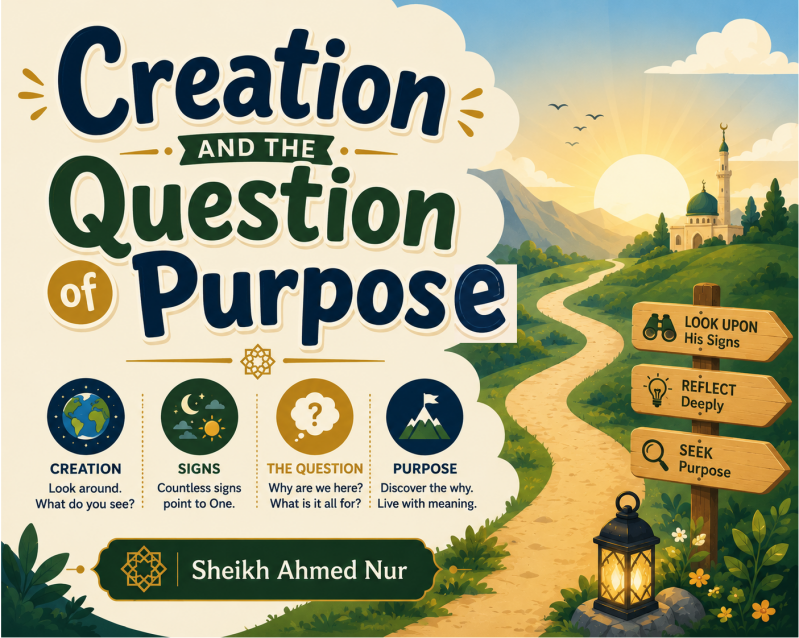

Long before we pause to ask what we are meant to do with our lives, we find ourselves in a world we did not choose and cannot claim to have made.
The sun rises each morning without waiting for our consent. Rain strikes parched earth, and within days, dry dust yields to green. Night surrenders to day. The stars wheel across the dark with a quiet precision that requires no human audience. Even within our own chests, the heart beats and lungs draw breath—performing a million silent tasks without a single conscious command from us.
We live inside a vast, complex order we did not build and cannot fully understand.
To observe this order is not to claim we have unlocked every mystery of the cosmos. It is simply to pay attention. And when we do, a quiet but persistent question begins to take shape:
Why is there so much coherence in the world around us?
When we walk into a house, we do not assume its rooms arranged themselves by chance. When we read a letter, we do not imagine ink spilled onto paper and accidentally formed meaningful syntax. We recognize intention because structure, by its very nature, points to a deliberate act behind it.
The cosmos presents this same logic on an immeasurably grander scale. The orbital mechanics of planets, the precise margins that allow for biological life, the staggering complexity of a single cell—all invite us to look more closely, not merely to describe what we see. The question is no longer merely how the universe operates. The deeper question is whether this existence was built with intent.
This is precisely the intuition the Qur’an validates. It does not ask us to set aside reason; it demands that we exercise it. It begins by dismantling the illusion of meaninglessness:
(وَمَا خَلَقْنَا السَّمَاءَ وَالْأَرْضَ وَمَا بَيْنَهُمَا بَاطِلًا ۚ ذَٰلِكَ ظَنُّ الَّذِينَ كَفَرُوا)
“We did not create the heaven and the earth and everything between them without purpose. That is the assumption of those who disbelieve.”
(Qur’an 38:27)
Notice how the Qur’an does not merely demand blind assent; it directs our gaze outward. It points to the physical world not as a meaningless backdrop, but as a deliberate communication. The sky. The earth. The subtle turning of night into day. The rain that brings dry ground back to life. The sweep of the winds. The clouds suspended between sky and earth.
And then, it draws its conclusion:
(إِنَّ فِي خَلْقِ السَّمَاوَاتِ وَالْأَرْضِ وَاخْتِلَافِ اللَّيْلِ وَالنَّهَارِ … لَآيَاتٍ لِّأُولِي الْأَلْبَابِ)
“Indeed, in the creation of the heavens and the earth, and in the alternation of night and day, and the ships which sail through the sea with that which is of use to mankind, and the water (rain) which Allah sends down from the sky and makes the earth alive therewith after its death, and the moving (living) creatures of all kinds that He has scattered therein, and in the veering of winds and clouds which are held between the sky and the earth, are indeed Ayat (proofs, evidences, signs) for people of understanding.”
(Qur’an 3:190)
The physical world, then, is not mere scenery we are meant to pass through blindly. It is a text to be read. Creation invites us to observe, to reflect, and to understand.
And once we learn to read the world in this way, the question inevitably turns inward.
If the universe is not a cosmic accident, then the human being—the singular creature capable of studying it, questioning it, and marveling at its beauty—cannot be a meaningless accident within it. The search for purpose is no longer just about the stars above us. It becomes a question about us.
Why Are We Here?
We cannot answer this by merely listing our survival needs. Food, shelter, labor, and security form the baseline of existence, not its summit. They explain how we stay alive; they do not explain why we are alive at all. A person can secure every material comfort, achieve every worldly success, and still lie awake in the dark, haunted by the quiet, persistent ache of a life without meaning.
The universe raises the question of purpose through the silent language of stars and seasons. But within human consciousness, that question finds its voice. We are not merely inhabitants of a world we did not make; we are conscious of it. We can observe it, reflect upon it, and ask why it exists.
Perhaps, in that very act of asking, the search for purpose truly begins.
By: Sheikh Ahmed Nur
Add comment
Comments