

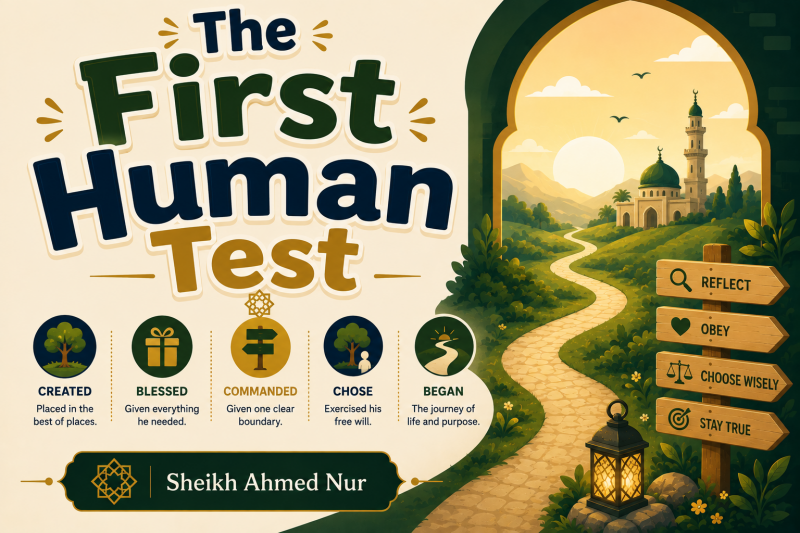

Adam opened his eyes to a world humanity would never know again.
Before human beings learned to build shelters, cultivate the earth, bury their dead, and struggle to secure what they needed, there was Paradise. There was no hunger to overcome, no fear of tomorrow, and no uncertainty about survival. Adam was surrounded by provision, beauty, and peace. He had been given abundance and was free to enjoy it.
But abundance did not mean the absence of responsibility.
Among everything that had been given to him, one limit had been set.
One tree.
Allah had already willed for human beings to live on earth and carry a great responsibility there. Adam would not enter that life without preparation. Before his feet touched the ground of this world, he was given a first lesson in what it meant to be human.
Human life would require more than existence. It would require knowledge and choice: the ability to recognize what is right when something else is desired, to understand that actions have consequences, and, after falling, to know how to return.
The first lesson began in Paradise.
The command was clear. Allah had made much permissible and forbidden only one thing. Adam was not left uncertain about the boundary.
Then Satan approached.
He did not force Adam to act. He did not erase the command from Adam’s memory. He only needed to make disobedience appear attractive.
Allah tells us that Satan said:
(فَوَسْوَسَ إِلَيْهِ الشَّيْطَانُ قَالَ يَا آدَمُ هَلْ أَدُلُّكَ عَلَىٰ شَجَرَةِ الْخُلْدِ وَمُلْكٍ لَا يَبْلَىٰ)
“But Satan whispered to him, saying, ‘O Adam! Shall I show you the Tree of Immortality and a kingdom that does not fade away?’”
— Qur’an 20:120
Nothing about the tree had changed.
Allah’s command had not changed either.
Satan changed the story around it.
What had been forbidden was presented as something Adam was missing. The boundary was made to look like deprivation. A prohibition was dressed up as an opportunity. Satan attached promises of immortality and power to the very thing Allah had prohibited.
That pattern did not disappear with Adam.
Wrongdoing rarely introduces itself by its real name. It finds another name first.
Greed may call itself financial security. Pride may call itself self-respect. Revenge may borrow the language of justice. Indulgence may present itself as freedom. The action remains what it is, but the mind begins changing the words around it until what is wrong starts to sound reasonable.
The Qur’an warns:
(إِنَّ الشَّيْطَانَ لَكُمْ عَدُوٌّ فَاتَّخِذُوهُ عَدُوًّا إِنَّمَا يَدْعُو حِزْبَهُ لِيَكُونُوا مِنْ أَصْحَابِ السَّعِيرِ)
“Surely Satan is an enemy to you, so take him as an enemy. He only invites his followers to become inmates of the Blaze.”
— Qur’an 35:6
Yet an enemy does not always attack openly. Satan does not always arrive with an obvious invitation to evil. Sometimes the suggestion comes through fear. Sometimes through desire. Sometimes through delay.
Not now.
Tomorrow.
There will be time.
A person may know that something good needs to be done and keep postponing it until the opportunity disappears. He may recognize that something is harmful and still tell himself:
Just once.
It will not matter.
I can repent later.
The whisper does not always sound like temptation. Often, it sounds like common sense.
But desire itself is not the enemy.
Hunger, love, the search for beauty, the longing for safety, and the pursuit of knowledge belong to human nature. Desire moves people to marry, work, learn, build, and create. It gives energy to human life.
The problem begins when desire becomes the authority.
Desire knows what it wants. It does not always know what is good.
For this reason, Allah did not create the human being with appetite alone. He gave human beings intellect, conscience, memory, and the ability to reflect. The mind can consider consequences. Conscience can recognize a boundary. Memory can recall what a person knew before desire began searching for excuses.
Allah also gave human beings the ability to remember Him.
That remembrance changes the way a person faces temptation. It reminds him that no choice is hidden from Allah and that the urgency of the moment is not the whole of reality. When temptation narrows his vision, remembrance restores perspective. It brings back what desire had pushed out of sight.
Then comes the moment of choice.
Between an impulse and an action, there is often a pause. It may last only a few seconds. The desire rises. The mind begins producing reasons. Yet another awareness remains beneath the noise:
You know better.
Human life is filled with such moments. Anger rises before words are spoken. A hand reaches toward something it should leave alone. An opportunity offers immediate pleasure while concealing a cost that may last for years.
First comes the attraction.
Then comes the argument.
The Prophet ﷺ described this inner struggle in a hadith narrated by ʿAbdullah ibn Masʿud:
The Messenger of Allah ﷺ said:
“Indeed, Satan has an influence upon the son of Adam, and the angel also has an influence. Satan’s influence is to promise evil consequences and deny the truth, while the angel’s influence is to promise good and affirm the truth. Whoever finds the latter should know that it is from Allah and praise Him. Whoever finds the other should seek refuge with Allah from Satan, the accursed.” The Prophet ﷺ then recited: “Satan threatens you with poverty and commands you to immorality.” (Qur’an 2:268)
The hadith describes an important part of the human inner struggle. Not every thought that enters the mind comes from the same place or leads in the same direction. One influence encourages fear, false reasoning, and a rejection of what is true. The other calls a person toward goodness and helps him recognize the truth.
— Jamiʿ at-Tirmidhi 2988, narrated by ʿAbdullah ibn Masʿud
Yet neither influence removes human freedom.
A thought is not yet an action.
A temptation is not yet a sin.
An impulse can rise and still be resisted. A person can stop, think, and refuse to act on what has entered the mind.
That is where the real struggle takes place.
The same intelligence that can recognize the truth can also become skilled at avoiding it. Reason can search honestly for what is right, or it can become a brilliant lawyer for a decision that desire has already made.
People may know what is right and still resist following it.
The Qur’an describes what can break this pattern:
(إِنَّ الَّذِينَ اتَّقَوْا إِذَا مَسَّهُمْ طَائِفٌ مِنَ الشَّيْطَانِ تَذَكَّرُوا فَإِذَا هُمْ مُبْصِرُونَ)
“Indeed, when Satan whispers to those mindful of Allah, they remember their Lord, then they start to see clearly.”
— Qur’an 7:201
The verse does not describe people who never experience temptation. It does not describe people without anger, fear, desire, or attraction. It describes people who remember Allah when those forces begin to cloud their judgment.
Remembrance does not necessarily remove the desire. It changes its position. The desire may still be present, but it no longer fills the entire view. The excuse loses some of its power. What temptation had pushed into the background returns to the mind.
The person sees the boundary again.
This was the heart of Adam’s first test.
He had freedom, but freedom did not mean the absence of limits. He had desire, but desire did not have the authority to decide what was true. He faced temptation, but temptation did not take away his ability to choose.
The boundary was crossed.
The mistake was made.
The consequences were real.
Human actions carry weight. One wrong decision can make the next one easier. What is repeated becomes familiar, and what becomes familiar can become a habit. Over time, habits begin to shape character.
A person may begin with the words, “Just once.”
Then comes another explanation.
Then another.
Eventually, the greatest difficulty may no longer be resisting the wrong. It may be admitting that the wrong was wrong.
This is where the story becomes larger than the mistake.
Adam did not defend what he had done. He did not turn his sin into an argument against Allah’s command. He did not say, “This is simply who I am.” Nor did he blame Satan as though the choice had been made for him.
He returned.
He and his wife said:
(رَبَّنَا ظَلَمْنَا أَنْفُسَنَا وَإِنْ لَمْ تَغْفِرْ لَنَا وَتَرْحَمْنَا لَنَكُونَنَّ مِنَ الْخَاسِرِينَ)
“Our Lord! We have wronged ourselves. If You do not forgive us and have mercy on us, we will certainly be losers.”
— Qur’an 7:23
There is no argument in those words.
No “but.” No attempt to make the wrong appear right.
Only an honest admission:
We have wronged ourselves.
Responsibility begins there. Before a person can truly turn back, he must be willing to see what he has done without excuse, disguise, or self-deception.
Then Allah says:
(فَتَلَقَّىٰ آدَمُ مِنْ رَبِّهِ كَلِمَاتٍ فَتَابَ عَلَيْهِ إِنَّهُ هُوَ التَّوَّابُ الرَّحِيمُ)
“Then Adam was inspired with words of prayer by his Lord, so He accepted his repentance. Surely He is the Accepter of Repentance, Most Merciful.”
— Qur’an 2:37
And later:
(ثُمَّ اجْتَبَاهُ رَبُّهُ فَتَابَ عَلَيْهِ وَهَدَىٰ)
“Then his Lord chose him for His grace, accepted his repentance, and guided him rightly.”
— Qur’an 20:122
The sequence is simple, but its meaning is profound.
Adam fell. He acknowledged what he had done. He repented. Allah accepted his repentance. Then Allah chose him and guided him.
The fall was real, but it was not final.
Adam’s story, therefore, is not merely the story of a human being who failed. It is the story of what follows failure when a person refuses to hide behind excuses and refuses to let shame keep him from returning to Allah.
A mistake may become part of a person’s history without becoming the direction of his life. Failure may leave a mark without having the authority to define who he becomes.
This is the difference between regret and repentance. Regret may leave a person looking backward, trapped in what has already happened. Repentance faces the truth, accepts responsibility, and then turns back.
Adam, peace be upon him, did not deny the fall. He faced it. He did not allow it to become the final word about who he was.
Allah accepted his repentance, chose him, and guided him.
The final word did not belong to the mistake.
It belonged to repentance, mercy, and guidance.
Adam’s descent to earth must also be understood correctly. It was not the consequence of failure.
Earth was not an unexpected alternative after Allah’s plan had been disrupted. Before Adam was created, Allah had already said:
(وَإِذْ قَالَ رَبُّكَ لِلْمَلَائِكَةِ إِنِّي جَاعِلٌ فِي الْأَرْضِ خَلِيفَةً قَالُوا أَتَجْعَلُ فِيهَا مَنْ يُفْسِدُ فِيهَا وَيَسْفِكُ الدِّمَاءَ وَنَحْنُ نُسَبِّحُ بِحَمْدِكَ وَنُقَدِّسُ لَكَ قَالَ إِنِّي أَعْلَمُ مَا لَا تَعْلَمُونَ)
“Remember when your Lord said to the angels, ‘I am going to place a successive human authority on earth.’ They asked, ‘Will You place in it someone who will spread corruption there and shed blood while we glorify Your praises and proclaim Your holiness?’ Allah responded, ‘I know what you do not know.’”
— Qur’an 2:30
Life on earth was already part of what Allah had willed for humanity.
Paradise was not a failed destination.
It was the first lesson.
Before humanity entered a world of need and abundance, pleasure and pain, success and failure, obedience and disobedience, the essential conditions of human life had appeared in their simplest form.
There was freedom.
There was a boundary.
There was desire.
There was temptation.
There was choice.
There was consequence.
And there was a way back.
Human life would become far more complicated. People would spread across the earth, build homes and cities, raise families, gain wealth and lose it, make peace and wage war. They would discover new ways to create and, at times, new ways to destroy.
But the inner struggle would remain.
Desire would continue to speak.
Satan would continue to whisper.
Conscience would continue to warn.
The mind would sometimes seek the truth and sometimes search for reasons to avoid it.
Every human being would face some version of Adam’s moment.
Not the same tree, but a boundary.
Not the same words, but a thought that makes crossing the boundary seem reasonable.
Not the same mistake, but the same human capacity to choose.
That is why Adam’s story has never belonged to Adam alone.
It is the story of human nature: wanting something and knowing that wanting it does not make it right; hearing a convincing argument and understanding that cleverness is not the same as truth; feeling desire pull in one direction while conscience calls from another; falling, and then deciding what happens next.
Desire will always be part of human life, and temptation can be resisted. The danger begins when wanting something becomes the reason for deciding that it is right.
When a person begins to call the forbidden permissible simply because he wants it.
Adam’s first test began with a tree.
But it was never only about a tree.
It was about the human being standing between desire and guidance, between freedom and responsibility, between a whisper that makes the wrong appear attractive and remembrance that brings the truth back into view.
It was also about what happens after failure: whether pride will defend the mistake or humility will lead a person back to Allah.
The lesson began in Paradise.
It continues in every human life.
The garden is no longer around us. The tree is no longer before us. But the boundary remains.
The whisper remains.
The struggle remains.
And so does the way back.
By: Sheikh Ahmed Nur
Add comment
Comments